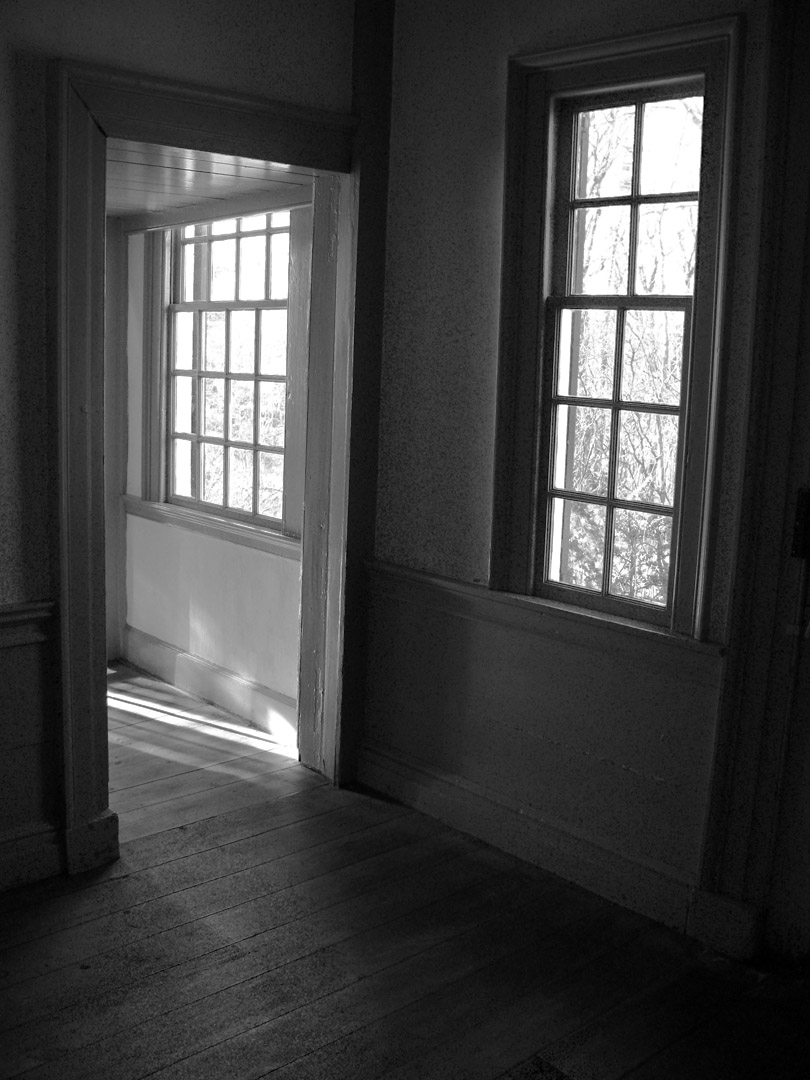
Windows, angles and shadows at the Ford Mansion
Posted by newjerseyology | Filed under Artsy Photo
07 Wednesday Mar 2012
07 Wednesday Mar 2012
Posted in Main Event
In 1779, Long Island Sound froze so solid that Connecticut yentas could skate to New York City to shop for shoes.

George, wishing for a day off with Elios frozen pizza and bad tv
OK, the part about yentas isn’t really true. But the rest is accurate. Accounts from the Revolutionary War detail the brutal winter, when temperatures of 13 degrees below zero were commonplace in New Jersey, people could walk across the thick ice of New York Harbor, and transportation by horse was impossible due to snow six feet deep. Where was this weather when we were children hoping to get a day off from school? Unfortunately for George Washington and his troops, there was no time for sledding and eating Hot Pockets in front of I Love Lucy reruns. More serious endeavors were at hand, namely fighting the war of independence from England.
Washington set up headquarters in a private home in Morristown and installed his troops five miles away at Jockey Hollow, an expansive park of forest and field, and in modern day, a visitor’s center and world-class pay phone.
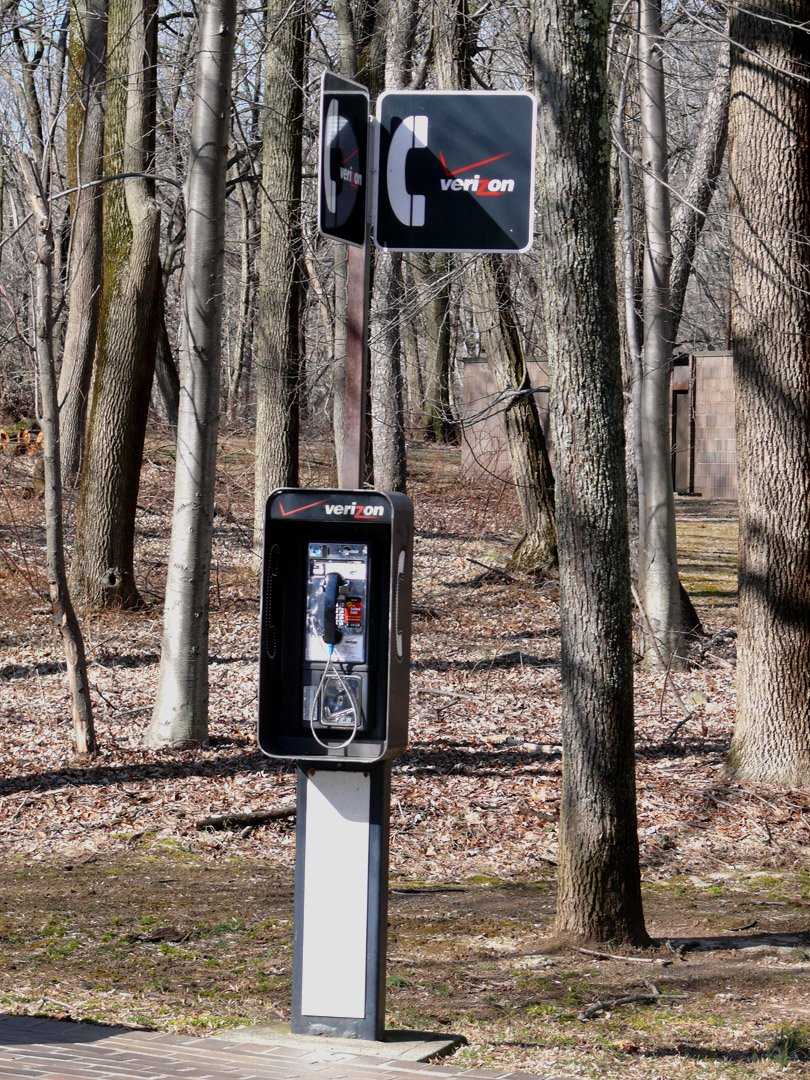
You don't see public blowers like this too often in 2012, never mind 1779
The visitor center store had a cute collection of Revolutionary memorabilia for sale and a jovial attendant who was very knowledgeable about the rest rooms. A short walk up the path behind the building is the Wick House, an idyllic little farm with gardens, orchards and an invitingly puffing chimney.

The Wick House--adorbs!
The property, owned by Captain Henry Wick, was commandeered by the Continental Army in 1779. Major General Arthur St. Clair inhabited the house, while his troops (known as the Pennsylvania Line) summarily denuded 600 of the estate’s 1400 lush acres for food, hut-building and fire-making. The winter was rough, with soldiers reportedly boiling and eating their shoes in famished desperation. Still, we think it must have been lovely in peacetime.
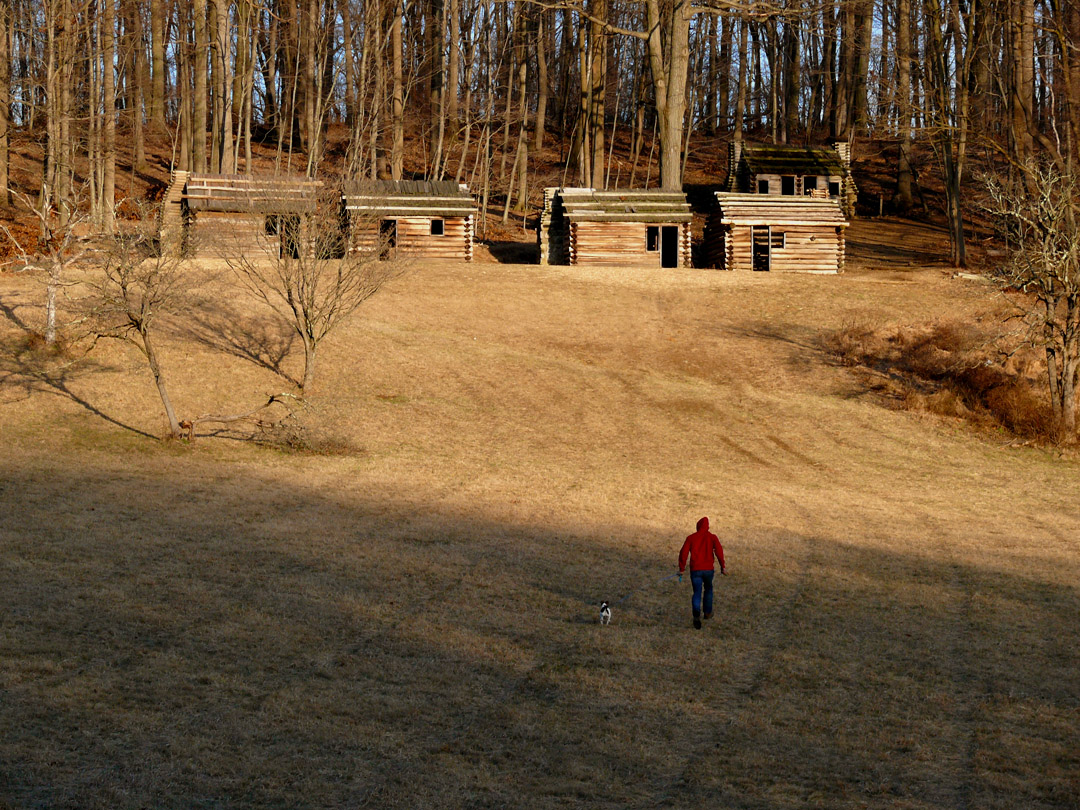
Cole Haan, yum!

Make room for George
Having discovered, however, that we were not at Washington’s Headquarters as we originally thought (no tours here, no sir!) we drove up Rte. 202 to the Ford Mansion, just a few turns off the main square of Morristown. Our strapping first President and his closest aides and servants rented (aka took over) this large Georgian house for seven months, managing the war, cuddling with Martha (who called him “Old Man”), entertaining up to 100 guests at a time, preparing huge meals and generally making a nuisance of themselves to homeowner and widow Theodosia Ford and her four children. The imposing abode, situated directly in front of the Washington Headquarters Museum, is now lovingly maintained as an historic site by the National Park Service.
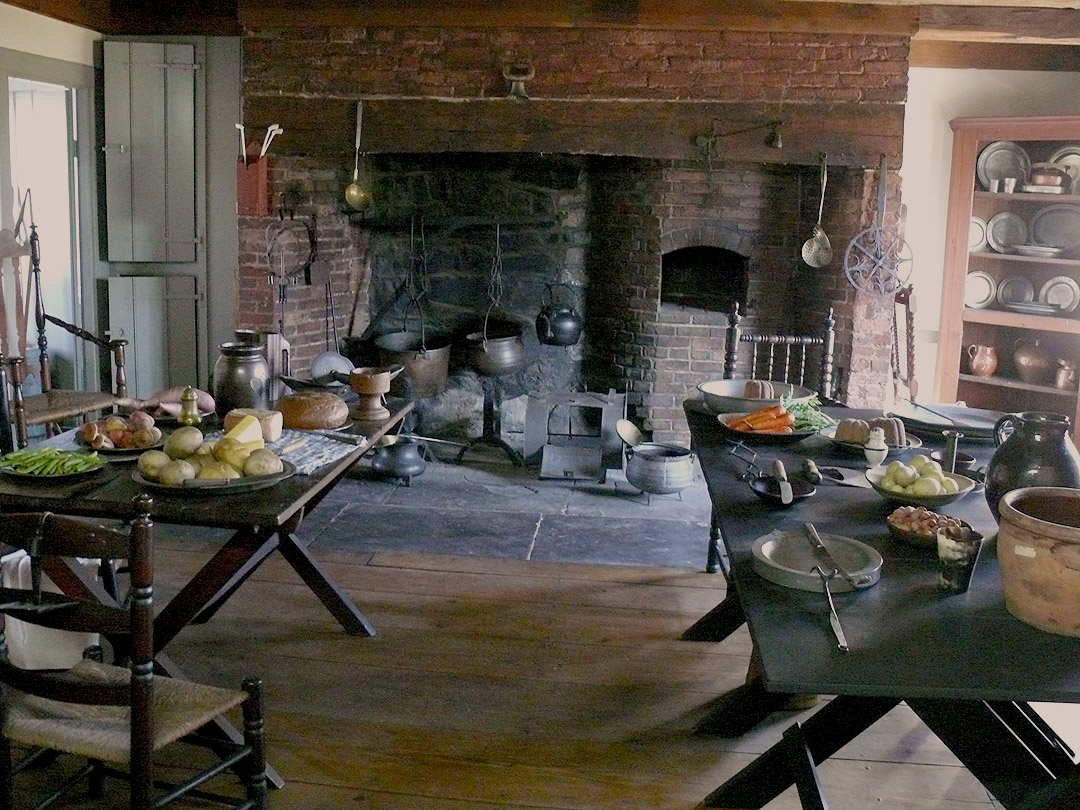
The kitchen looked inviting

Washington Headquarters Museum
We purchased tour tickets ($4 each) and viewed half the museum before our guide, Kevin, arrived. A throwback to Jellystone Park down the the last detail, Kevin tried in vain to corral the garrulous and unruly pair of toddlers who would haunt the remainder of our experience.
Eventually he gave up, provided some background and walked us up to the mansion, the door of which he opened with a comically large key.

Key of a size befitting our first Prez
Inside was a trove of Washington and time period artifacts—writing desks, kitchen accoutrements, eyebrow windows, mini beds, armoires and so forth—accessed via plank oak floors and winding staircases. Kevin narrated with gusto for our little group, though at times our patience ran out for the undisciplined children with their infernal tootling and inane question-asking. That aside, the tour was informative and neither too long nor too short in length, giving us a few minutes to finish perusing the museum and purchase a small tome of GW’s wisdom.
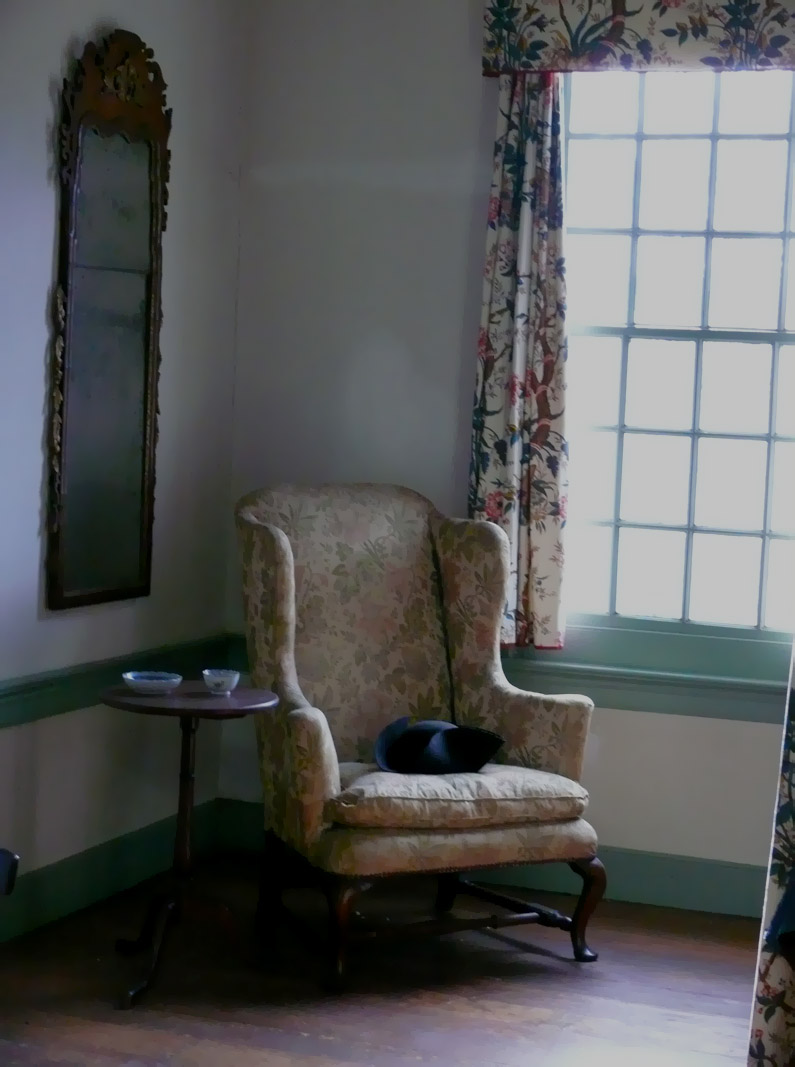
The mirror is an original and likely used by GW
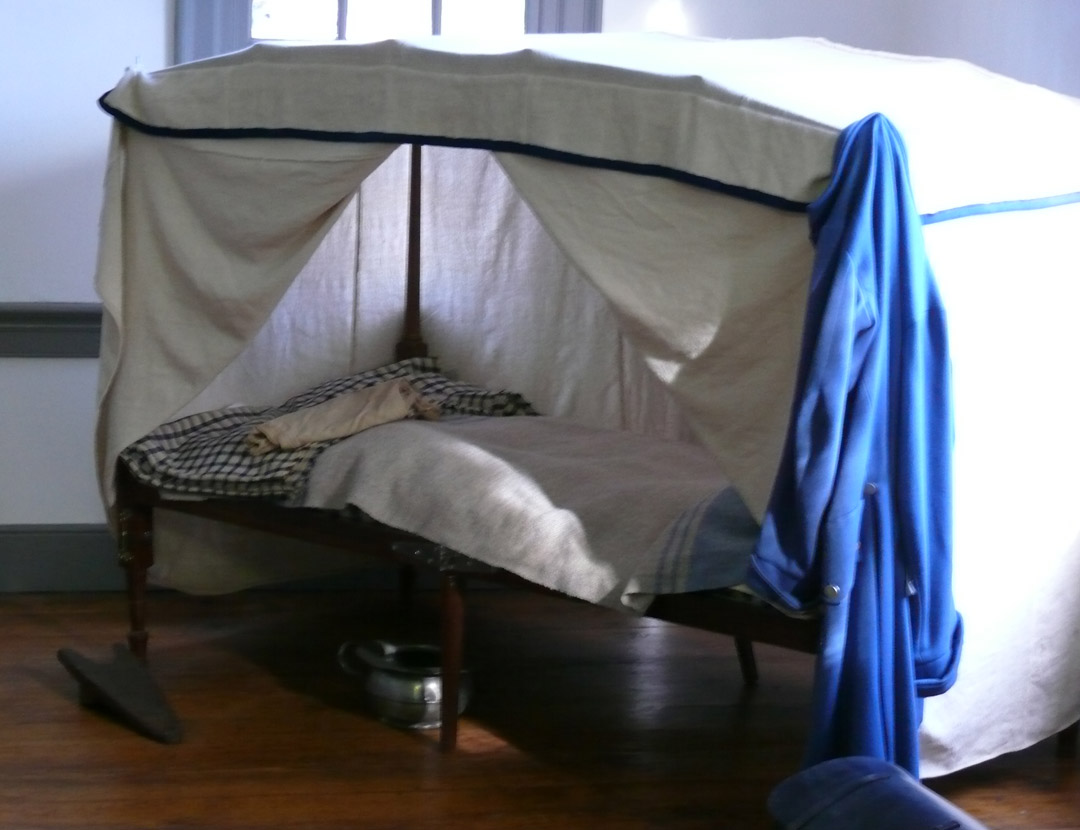
Tiny beds, not for dwarves, but for people who slept nearly upright due to fears they would stop breathing
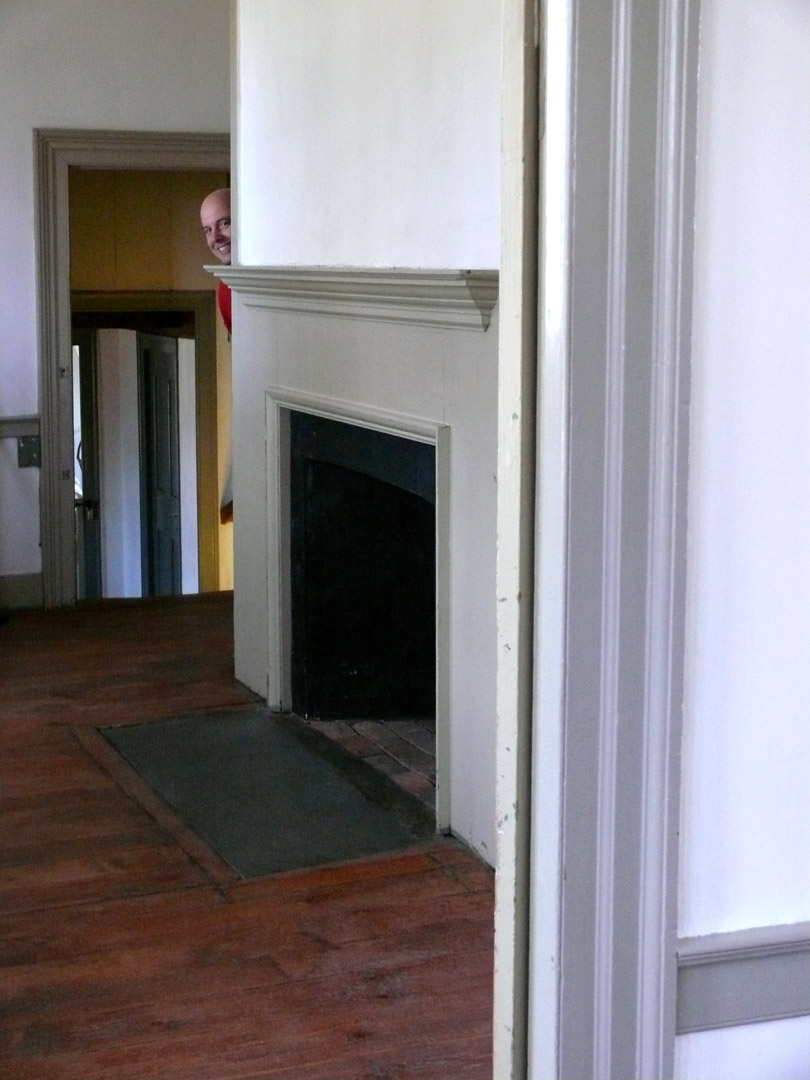
Doors everywhere
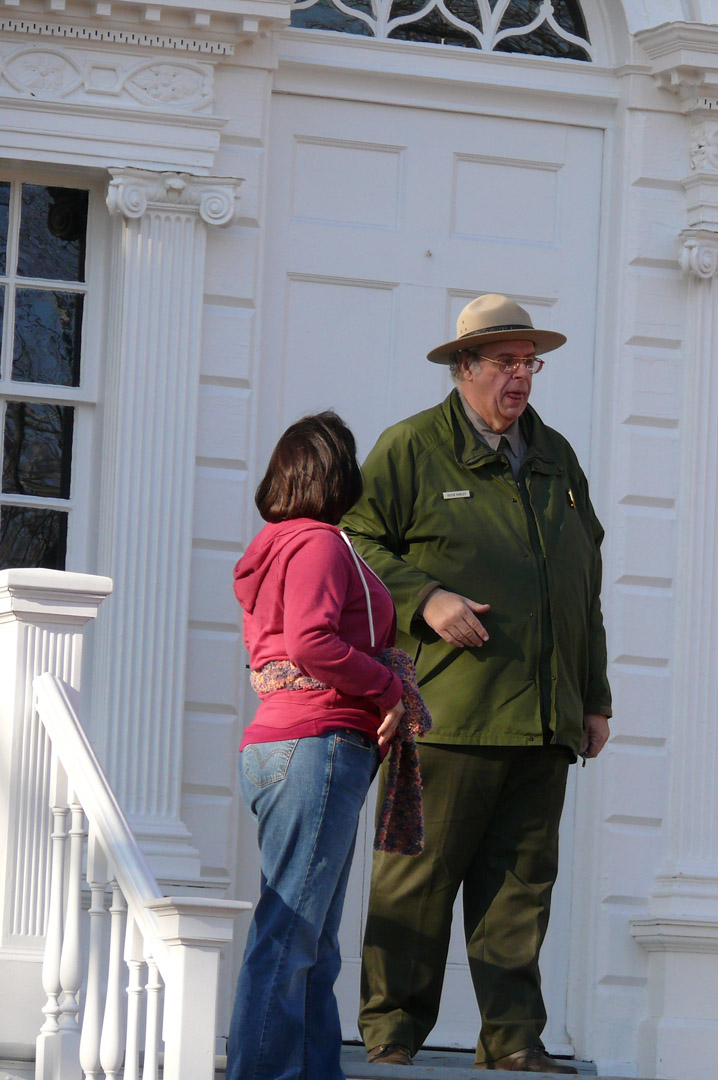
Kevin of Jellystone Park

Statue of GW and his horse, Blue
Final stop: Fort Nonsense. Great name, but less going on at the site. Apparently George W. ordered his troops to build an earthen fortification on an overlook above Morristown, so as to be able to keep watch for the British. It never really amounted to a hill of beans, seeing no action whatsoever. People speculated that perhaps the fort was busywork for the soldiers, hence the name, but historians say this was highly unlikely and rather GW placed great value in “holding higher ground” as a matter of principle.

Stone marker

What better for Fort Nonsense? Soldier Ben mans the cannon.
It was a fun and educational day for almost zero cost. Click here for more information about Washington’s Headquarters, Jockey Hollow and Fort Nonsense.
04 Sunday Mar 2012
Posted in Culinary Sidebar
The readers of New Jersey Monthly are polled every year about the “best” of New Jersey in a bunch of categories. Inevitably, due to the readership profile, the results are skewed to include more winners from the northern part of the state. The comments section on the Best Of piece are sometimes more useful than the actual article, because apparently there is no better motivation for people south of Rte. 78 to sound off their opinions than to have their favorite pizza joint slighted. It’s expressing it roughly, but you get the drift.
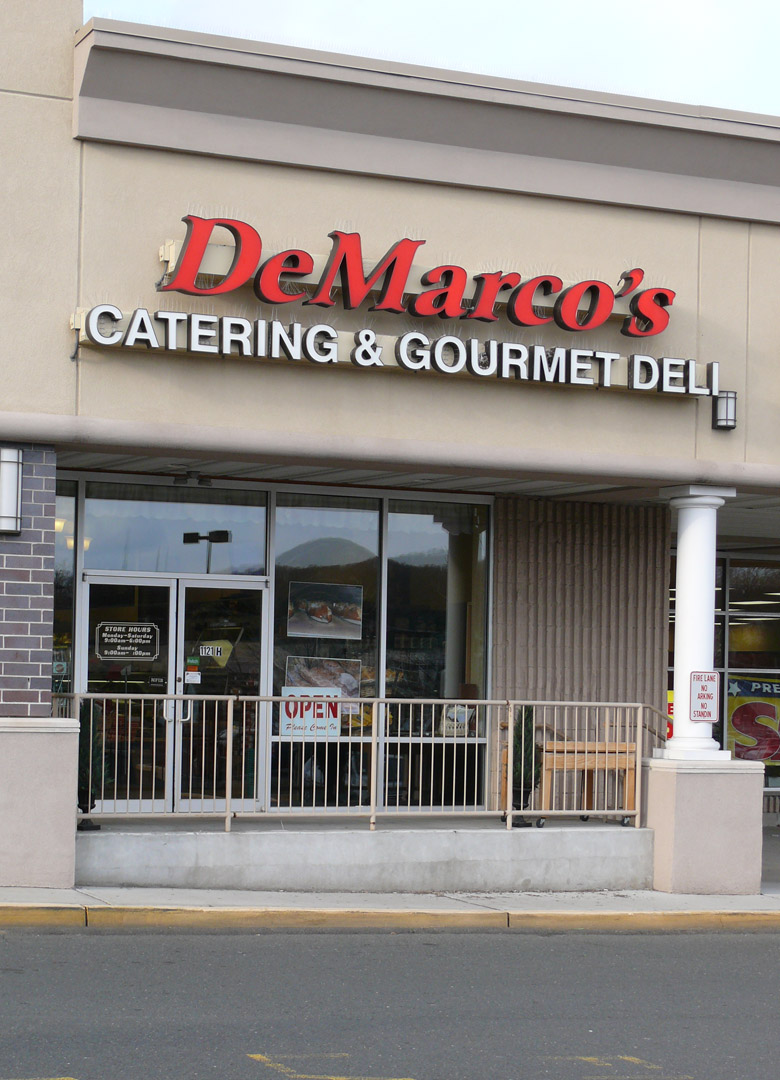
An unassuming storefront for bread that makes you go mmm
Anyhow, in the Bread category for 2011, Calandra’s Bakery of Newark took the top honors. The comments poured in online. How could you overlook DeMarco’s in Aberdeen? Well, we’d never heard of, nor been to DeMarco’s, but were intrigued and it was close by. Stopping in on a chilly Saturday, we perused the soso selection of Italian specialties, and plunked down the cash for a few samples of the yeasty goodness: a fruit and nut round, two onion rolls and an Italian loaf. We were not disappointed. The rolls and half of the fruit/nut round were gone before we left the parking lot, and we gobbled the rest by the next day. Balanced flavors, perfect texture and crust. Very recommended.
04 Sunday Mar 2012
Posted in Main Event
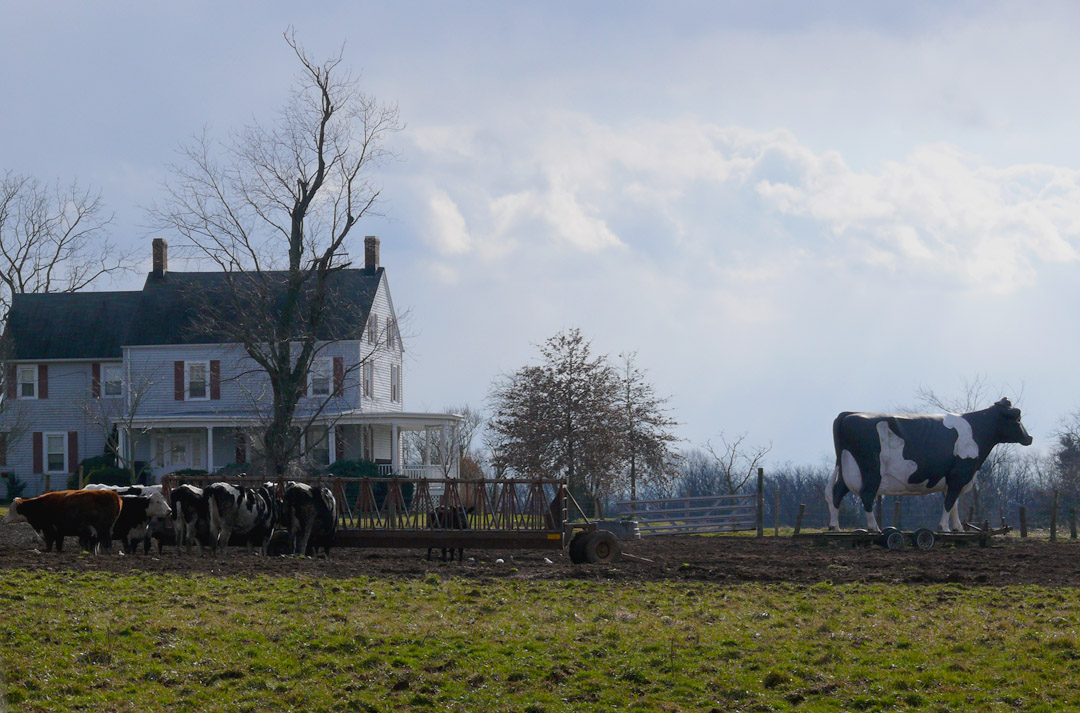
Is it real or is it fiberglass?
In a stretch of road dominated by power lines and energy plants, one might think a giant cow standing in a field is an outcome of technology gone haywire. Not so. A dairy farm on Bennett’s Lane in Franklin Township is home to an enormous fiberglass bovine statue on wheels, known as the “Big Cow of Middlebush,” where she is simply beloved eye candy. Like any good wheeled cow, she moves (or is moved?) around the field randomly to keep things fresh. Previously brown and white, she got a new coat of paint and literally changed her spots to black in 2009. Her real, living pasture mates seem totally nonplussed by her presence; Elsie no doubt would be proud to know her. The farm is private property, so we had to pull over into one of the power stations across the street (perhaps…also private property) and scamper up to the barbed wire fence to snap a photo.

She's probably seen 27,847 movies by now
A few jogs through New Brunswick and we arrived at the Loews Theater on Rte. 1–not to see the latest laughable Hollywood moneymaker–but to view the somewhat infamous resting place of Mary Ellis, a spinster from the late 1700s. Mary, alas, was duped by a cad sea captain who seduced and promised to marry her, only never to return. Legend has it that she stood like a sentinel on this piece of land to watch for his ship coming in on the Raritan River. She got a pretty bum deal. Not only did the jerk never write, take her dancing or show up whatsoever, but many years after her death and burial in 1827, her family property was sold to commercial interests. Her remains have since been witness to the operation of the Great Eastern Supermarket, the Rte. 1 Flea Market (bulldozed circa 1995) and finally the Loews Theater that currently stands.
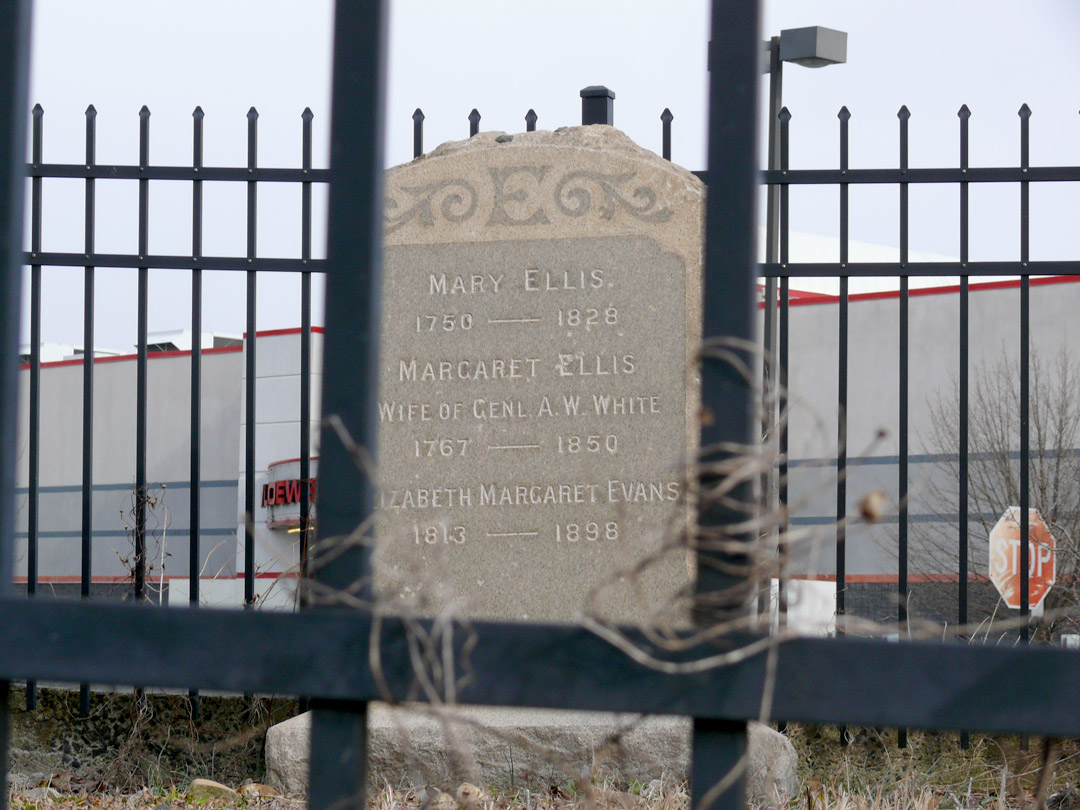
Sea captains always seem to be cads
The grave marker of Ms. Ellis is in a stone-walled structure behind the theater, about 7 feet above ground and surrounded by cemetery-style fence. We haven’t yet been able to find explanation of the many names appearing on the headstone. During our visit nobody seemed to be giving a second glance to this somber island in the center of the asphalt parking lot, and we were able to climb up the stone sides for photo opps without even the circulating security guard blinking an eye.

Even Ben paid his respects
Wanting to lighten the mood, we thought we’d make our last stop for the day at the Shipwrecked Ferry of East Brunswick (by no accounts the ship of Mary Ellis’ cad sea captain) that was visible for many years from the NJ Turnpike. This rusting hull sat polluting the Raritan River just beneath a Rte. 1 overpass, and was reportedly able to be seen from a vantage point near the Edgeboro landfill. Doing our duty as New Jerseyologists, we drove over to the area and proceeded through several no no-trespassing gates in search of this legendary watercraft. We saw many Gotham-city like pipes, rotting wood piles, dilapidated Winnebagos and the below ancient truck container advertising Green Stamps. The ferry eluded us, and for good reason: We later heard from an unconfirmed source that the ill-fated ship had been hauled away and scrapped some time ago. RIP, shipwrecked ferry!
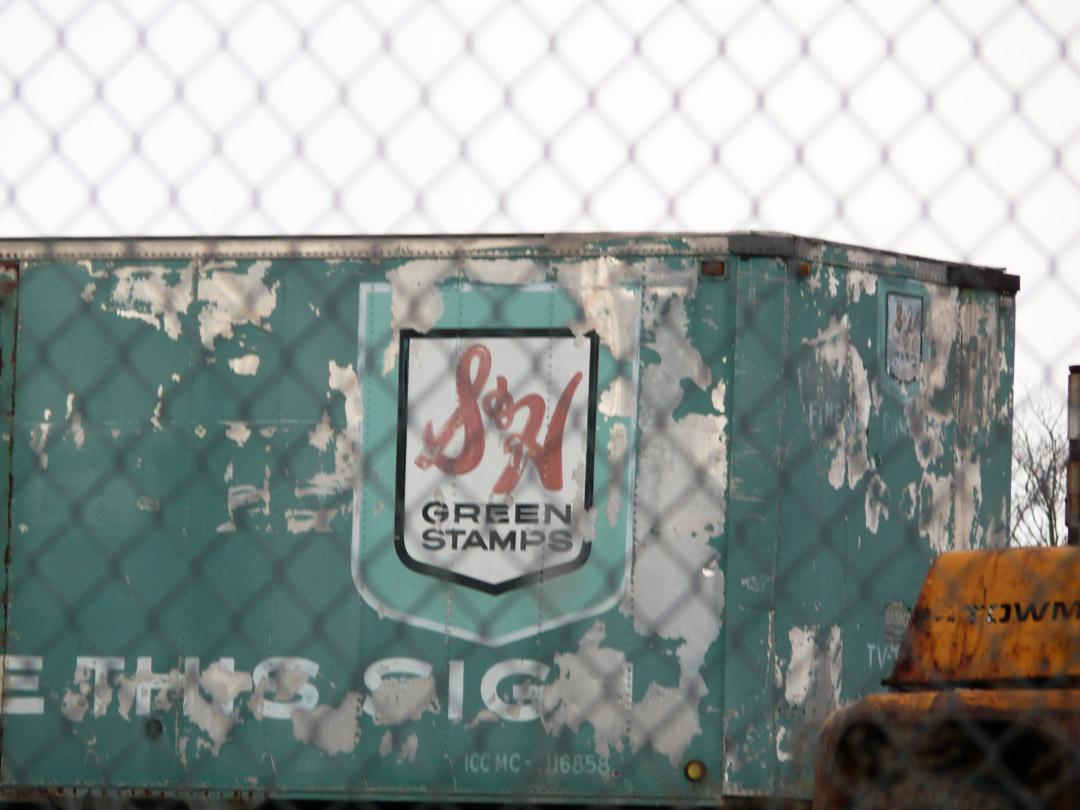
Ancient truck container
04 Sunday Mar 2012
Posted in Uncategorized
A couple of things caught our eye as we drove away from the Princeton area.

Darth Vader mailbox with shoulder ravens, Washington Road

Freedom to be humiliated on Rte. 27
04 Sunday Mar 2012
Posted in Main Event
Our next stop was just a few miles away in Plainsboro, to pay our respects to that great bovine marketing icon, Elsie the Cow.
Walker Gordon farm was not always the sprawling mass of willy-nilly “single family homes” that it is now—it once was a working dairy farm owned by the Borden company. Some background: In 1938, Borden introduced a cartoon spokescow known as Elsie to the milk-buying public, a marketing tactic intended to soften the company’s image after bad press over its dealings with striking farmers in New York State. It worked. Around the same time, Borden was also looking to build excitement over their invention of the “rotolactor,” a rotating platform/demented carousel that could auto-milk 50 unfortunate cows in 12.5 minutes, at the 1939 World’s Fair. Shockingly, nobody at the World’s Fair, or in the world, gave a flying leap about the rotolactor, especially between demonstration milkings. Something had to be done, and fast. Re-enter Borden’s crack marketing team.
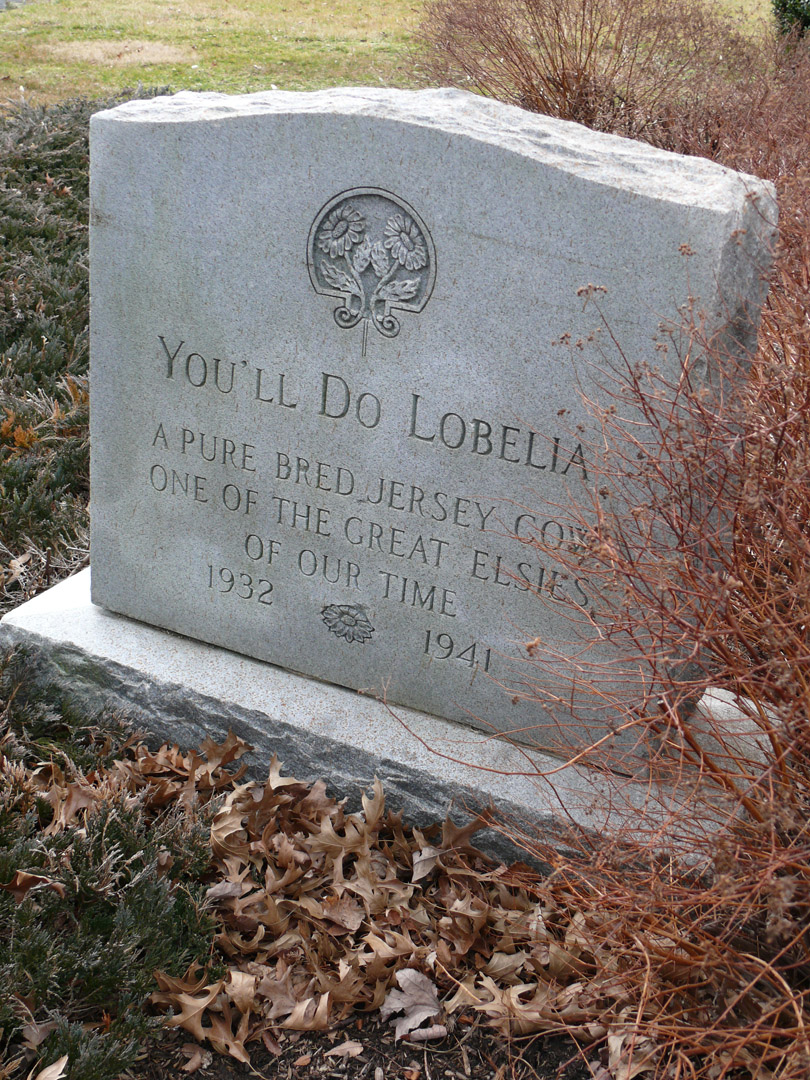
Moo
Some poor schlump who drew the short straw of monitoring the rotolactor exhibit all day was also tasked with noting down questions asked by the visiting public. A whopping 60% of the questions were the same: which cow is Elsie? “Aha!” thought the devious marketers, and in short order one of the cows (a Jersey heifer born in Massachusetts under the name “You’ll Do Lobelia” to be exact) was picked from the herd, outfitted with a necklace of daisies and placed on the rotolactor during non-demonstration times. And as usual, the public fell for it. Elsie soon had a milking “boudoir,” a husband named Elmer (he appears on the glue bottles and other Borden household products) and was traveling to promotional appearances all over the country in her own “Cowdillac.”
Like many celebrities after her, Elsie’s flame burned bright but short. In 1941, she was en route to an appearance at New York City’s Schubert Alley Theater when her Cowdillac was rear-ended by a truck in Rahway (a fate we’ve all feared at some time or another). She was very badly injured, and ultimately euthanized back at Walker Gordon farm.
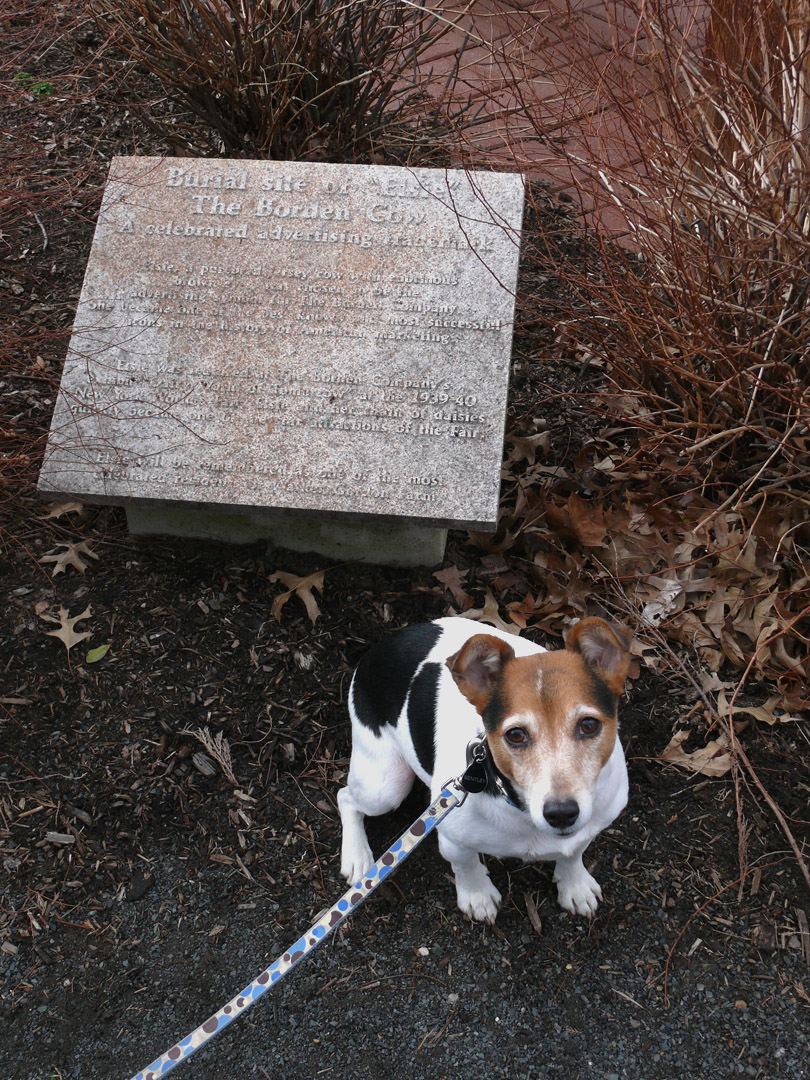
Ben next to the illegible granite slab
Elsie was buried on the farm grounds, and her grave marked by a traditional headstone. According to reports, this headstone has been moved around a bit, so who really knows which precise patch of grass Elsie’s remains are fertilizing today? Respects can still be paid at the headstone, knowing she’s not more than a few hundred feet away.
We had a spot of trouble finding the grave marker, and spent about 10 minutes first traversing and re-traversing the neighborhood’s overpopulated streets with bucolic names. It really shouldn’t be that difficult…because if you enter through the main gate, the first right is Heron Court, and then the grave marker is pretty much right in front of your face—just look for the gazebo off to the right—the headstone and commemorative plaque (which was a bit hard to read) are directly next to it. The wind really whipped up during our stop, somewhat unfortunately bringing with it strongly perfumed odors from the nearby Firmenich plant. We wondered how people live in the neighborhood not knowing which falsified aroma will greet them each morning…
04 Sunday Mar 2012

Fay Wray nowhere in sight
Oh, also at Van Nest Park was this cement circle with an embedded chain. Barbecue pit off season, or King Kong exploitation site??
Posted by newjerseyology | Filed under Uncategorized
04 Sunday Mar 2012
Posted in Main Event
An even later start and whipping 50-mile per hour winds did not deter us from seeking out some notable New Jersey sites on another particular weekend.
First stop, an unassuming little corner of West Windsor Township called Grovers Mill. It is not uncommon to witness mass hysteria on the particular stretch of Cranbury Neck Road that arcs in front of Van Nest Park—just take a look at the chaos of traffic in and around the area every rush hour afternoon. But in 1938, the populace of the area reached singular heights of hysteria when a radio broadcast announced rather convincingly that the village was being overrun by hostile Martian invaders. We know today that it was just an actor, Orson Welles, reading from a science fiction novel by, well, H.G. Wells. At the time, however, townsfolk interpreted as real the reports of pulsating aliens, heat rays, civilian casualties, martial law declarations and so forth, and reacted with appropriate levels of distress. It made the front page of the New York Times, catapulted Orson Welles to fame and put Grovers Mills on the map of the country’s collective consciousness. Listen to the original broadcast.

Welles v. Wells
We’re ashamed to admit that some of us have been passing Van Nest park by car for upwards of two decades without realizing its significance. It was a vindication of sorts, therefore, to make a pointed pilgrimage to see the War of the Worlds monument (designed by NJ resident Thomas Jay Warren), which the township erected in 1988 as an homage to the public safety debacle. Situated about 20 steps past the kiddie playground and picnic tables, the bronze memorial immortalizes the event, depicting in sculpted relief Welles at the microphone, an average American family listening to the broadcast and most importantly, a tentacled, careening space ship dispensing death rays from overhead. In a word: cool!
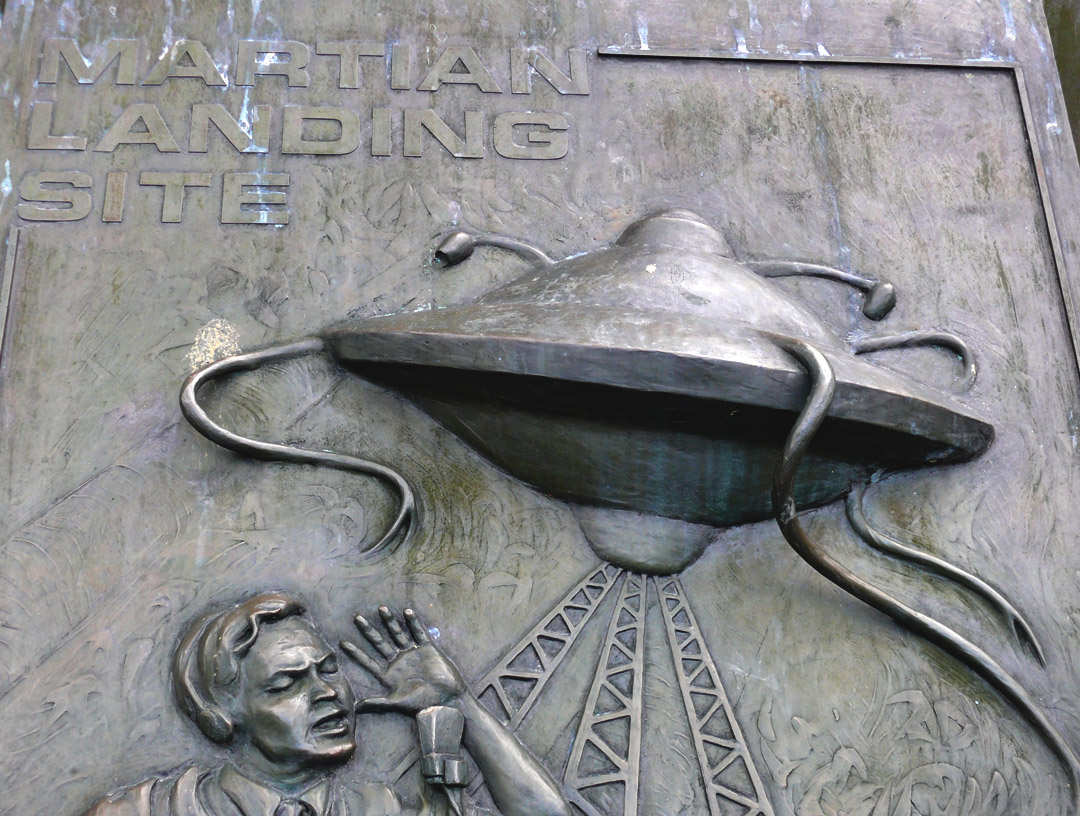
Martian tentacles

Millions fell for the hoax
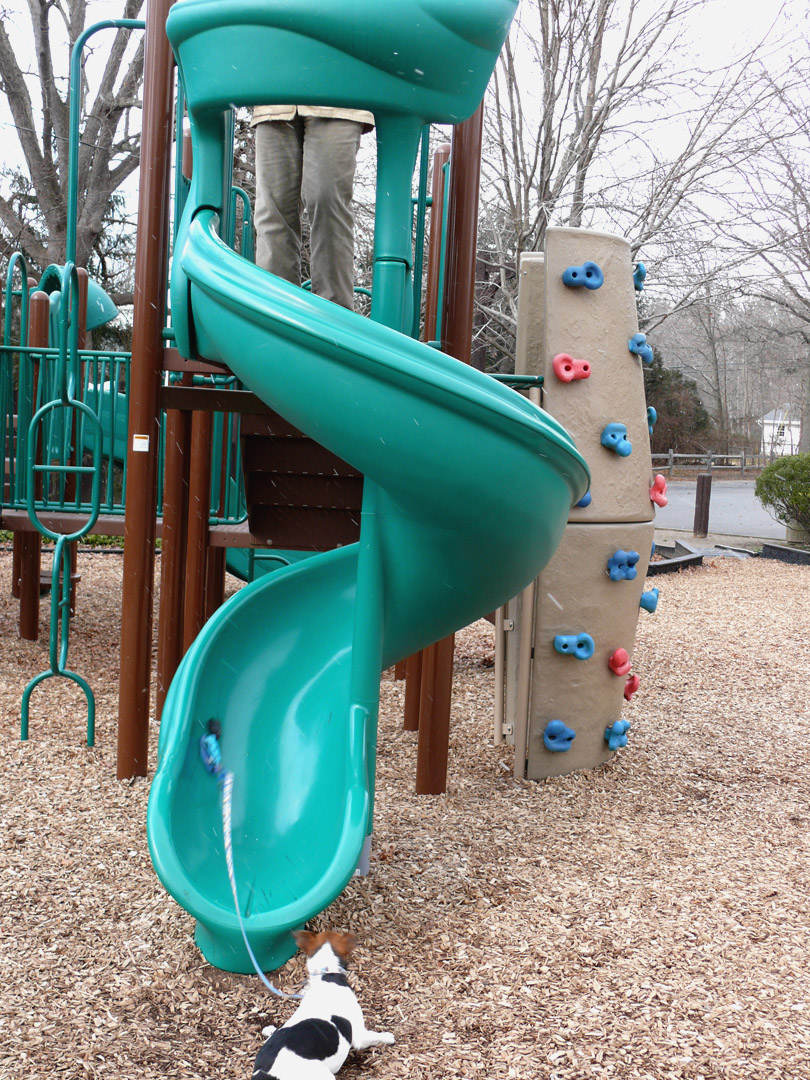
Ben after full rotation
Aside from a cute little waterfront and some barbecue pits there is not much else to see or do at Van Nest Park, but as New Jersey’s Roswell, it is a must to visit. For our part, for some added entertainment before leaving, we put Ben on the playground’s spiral slide—he descended quickly down, inverted on his back with paws flailing in the air, and ker-thumped on the ground in shock a second later, unhurt but anxious to get back to his travel crate.
03 Saturday Mar 2012
Posted in Main Event

Outside the mine offices
Despite a late start we made perfect time to the Sterling Hill Mining Museum in Ogdensburg, located about midway between Route 80 and the New York State border.
A little background: This zinc mine was operational from 1913 until 1986, when low zinc prices at market combined with a township back-taxes dispute forced The New Jersey Zinc Company to forfeit the property back to the Borough of Ogdensburg. In 1989 it the site was purchased at public auction by brothers Robert and Richard Hauck, who opened the site as a museum in 1990 despite it still containing 10 years worth of zinc ore; it is now run by a dedicated group of employees and volunteers.
It’s a bit of a rag-tag entrance, with what look like giant carriage wheels painted different colors, a seemingly incongruous astronomical observatory, and random piles of rubble greeting your arrival. The drive leads you past the main mine shaft and underneath the ore conveyor to an unassuming group of buildings, mine entrances, heavy equipment, mining statues and fenced areas for fossil digging.
We pulled into the little parking lot and like all good tourists immediately made a bee-line for the restrooms and snack bar, which charmingly offered a “traditional miner’s lunch” of Cornish meat pies and multi-hued rock candy in addition to a variety of chips, candy and incredibly tiny, limp, pizzas. (In fairness, the Sterling Hill website itself readily admits that the snack bar is for “the hungry and desperate.”) We opted for the safety of bagged trail mix, candy and mini versions of the Linden’s chocolate chip cookies we’d grown up on in elementary school…mmm…and noted that the bare-bones facility was humming with activity.

A crooked donkey toiling in the mines
Next we perused the gift shop, which was nicely stocked with all sorts of ore samples, rock-based statuettes, books, mineral collecting supplies, high-quality black lights and the curious piece of decor pictured left. We purchased only tickets—$10 a pop—and headed outside.

Nature’s steroids
Next to a pile of good-sized rocks with beautiful striations and crystal formations ($4 a pound, tempting for the garden, but we resisted) we met this eye-popping miner statue.
Honestly, who needed steroids when you worked 10 hour days, 6 days a week smashing through Earth’s crust? Oh and hey, real men are kind to canaries too!
Our guide (for the moment) then directed all 58 or so of us past random two-legged horse statues into the Zobel Exhibit Hall, where we got an introduction to the mine’s history and some background on zinc and the other minerals found onsite. It was very interesting despite the several young children on the tour complaining of being cold and making general annoyances of themselves.

Two legged horse
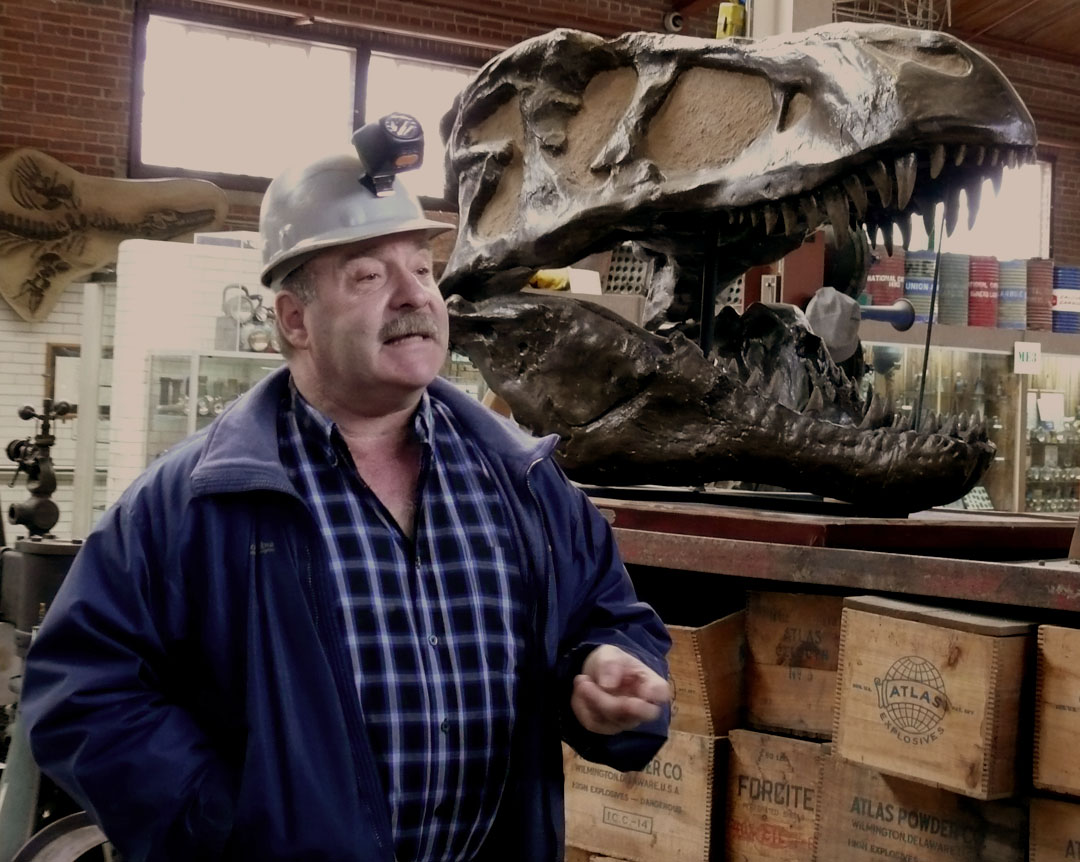
Our first guide, with dino-pal

Kaboom!
Apparently, the many boxes of now-empty blasting explosives were not enough to stop the Exhibit Hall from being robbed of a significant purse of gold a few years back. It nonetheless remains packed with riches, including an exotic collection of mineral specimens donated by guy who owns the Oreck vacuum cleaner company (of all people), and one of the world’s most impressive Periodic Table of Elements. Thankfully, no reports so far of thieves targeting the Table’s samples of Uranium and Plutonium.
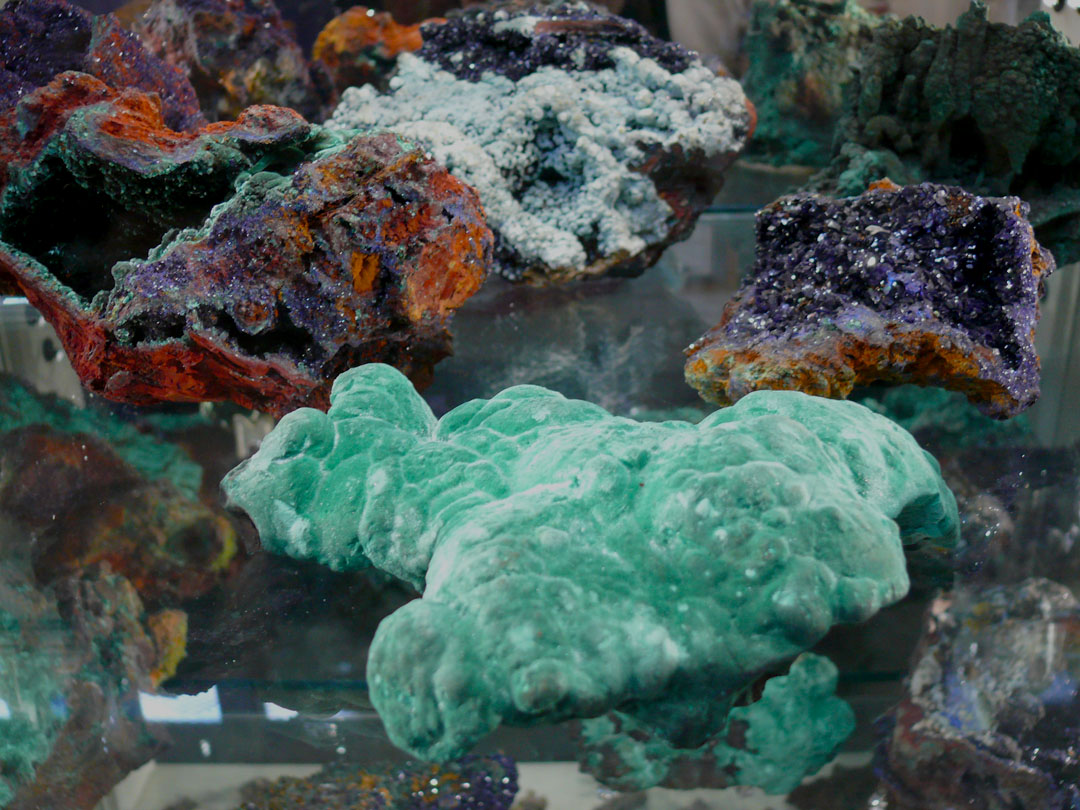
Sampling of Oreck’s minerals
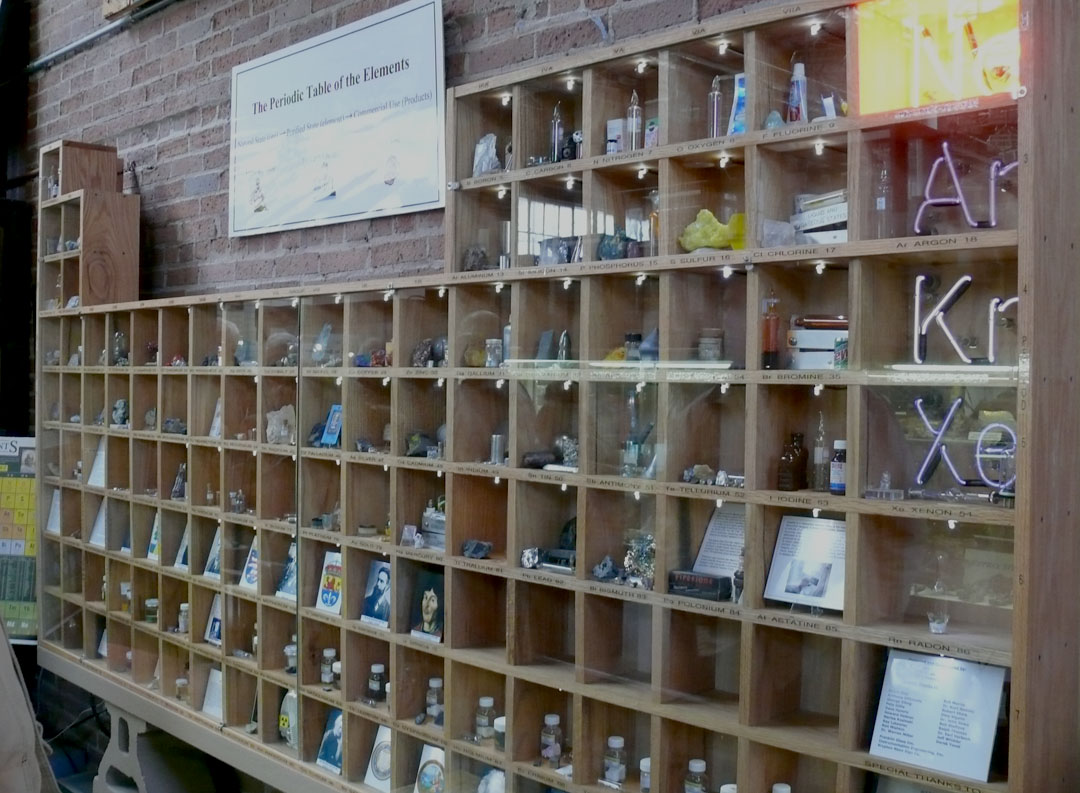
Periodic table of elements

Oopsie!
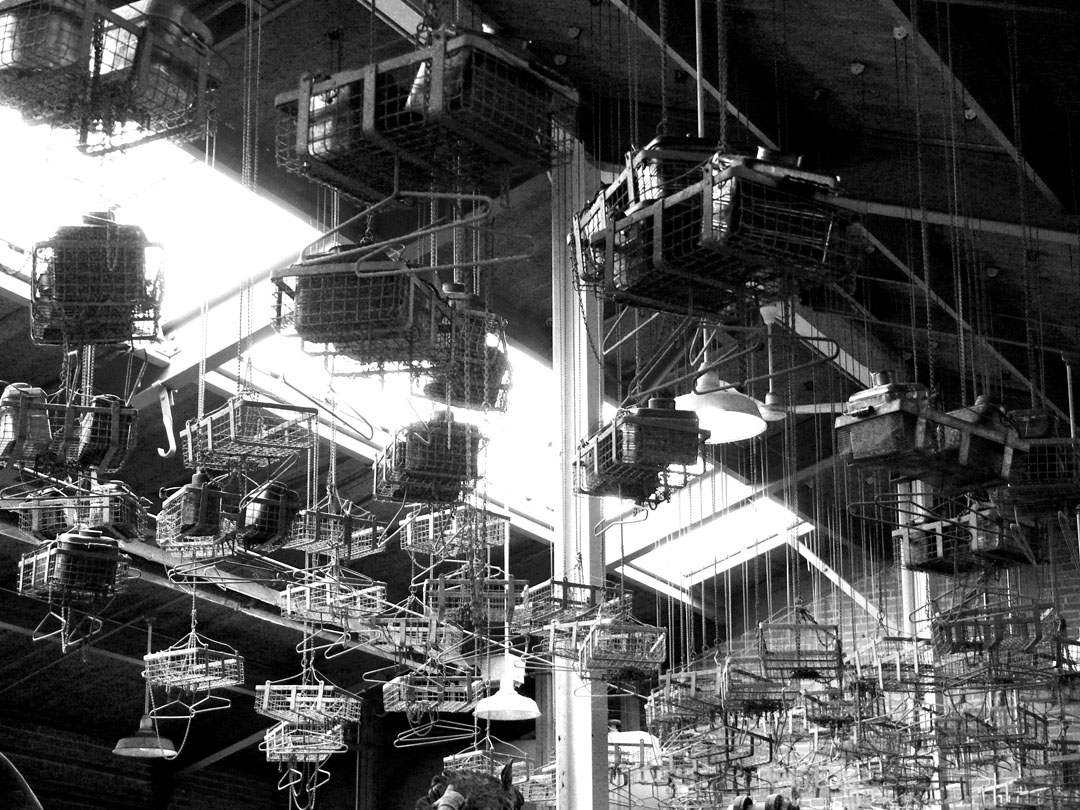
Laundry baskets
The Exhibit Hall is festooned with innumerable cage-like contraptions hanging on chains from the ceiling—not traps for underground blue claw crab-dwellers, as would be a natural supposition by any SyFy watcher worth their salt—but rather a way for miners to send their clothing to the surface for laundering by other people. Every teenager’s (ok, and adult’s) dream!
We broke into two groups and headed for the mine proper with our new and sassy guide, Gordon, a consultant engineer at the nearby Picatinny Arsenal, a military research and manufacturing facility specializing in small arms cartridge ammunition and home of the US Army’s Explosive Ordnance Disposal Technology Directorate. Mines, arsenals, buff statues…surely Sylvester Stallone has filmed a movie here? According to Gordon, no, only Ben Stiller, who set a scene in one of the mine’s rooms for Zoolander…
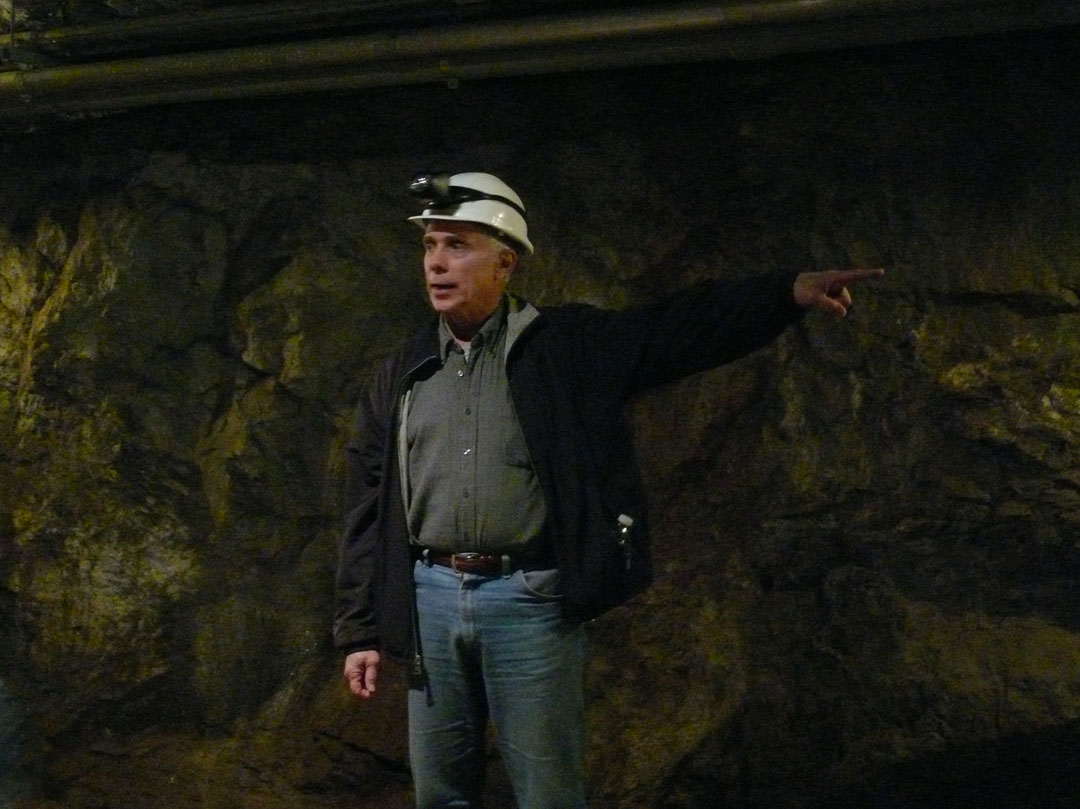
Gordon, our trusty guide
As soon as the steel door clanged shut, we couldn’t help but feel a tiny urge to…claw our hands raw, Edgar Allan Poe-style, digging back out into the fresh air and sunlight. But the pang quickly passed and we moved onward, into the 1300 feet of dank, dripping tunnels. We passed a lot of things that we can’t remember the names of now…but all decidedly fascinating: Stalactites that look eerily like teeth, water-filled shafts, mineral drips on the walls, bucket-of-lime toilets, arm-shearing transport systems, and a “mock” detonation demonstration of precisely 9 explosions performed in the nerve-wracking dark (Gordon has a sick sense of humor). And we learned: about light-up hats from candles to LED, the infamous tag system for monitoring staff whereabouts, gas leaks and black lung and respirators, technological advances in drill bits, mine flooding and much more. (Well, we did stump Gordon with one question about harvesting core samples…but we shall overlook it in deference to his charm.)
The mine’s Rainbow Room is a far cry from, and frankly an improvement over, New York’s now-defunct opulent restaurant-lounge (okay, it is now called Top of the Rock and still has fairly cool views too…). Its carved-out walls are inlaid with veins of fluorescent red and green zinc and willemite, which flared into spectacular view at the switch of the black light. To boot, everyone got their own little glowing chunk to take home, which made us all feel like happy schoolchildren despite some of us having graduated <unintelligible> years ago.
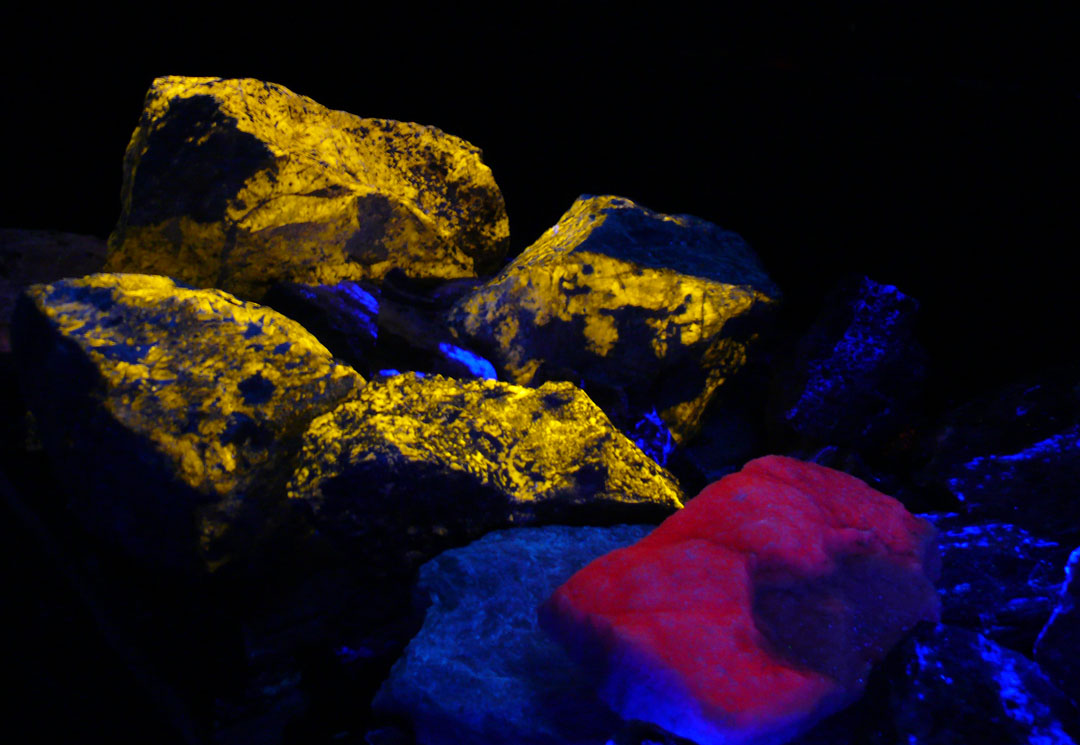
Fluorescence!
The Rainbow Room is just a precursor to the highlight around the dank, dripping corner: The Thomas S. Warren Museum of Fluorescence. Few things are as cool as this grouping of four rooms. The seemingly unremarkable collection turns into a prehistoric rave of phosphorescent color, shape and texture under black light. In addition to the minerals, there are a bunch of fluorescent household items (think wine glasses and cookie tins) on display, and also a black-lit mirror that horrifyingly revealed our mottled purple skin, straw-like hair, ping-pong ball eyes, lime green teeth and lint-covered hoodies. Fluorescent Funhouse, anyone?

Load of fuzzy cuteness!
A short jog through the Geotechnology Center, where we correctly identified a meteor and Earth-based rock to Gordon’s glee, and the tour was over. We took a moment to force Ben into one of the old mine cars outside of Edison’s Tunnel (named so for Thomas Alva, who seemingly has had a hand in all things in New Jersey, including this mine) for a photo opp and headed off for an early dinner.
Synopsis: The Sterling Hill Mining Museum was a NJ venue well worth the trip and price of admission. We got our money’s worth, with a really unique 2+ hour tour (flat walking surface a plus for those with old broken ankle injuries), take-home rock sample and ample entertainment from feisty guides.
03 Saturday Mar 2012
Posted in Culinary Sidebar
Post-mine, we ate at an Irish pub in Dover called The Quiet Man, named for the eponymous John Wayne movie. Rave reviews from two vegetarians, a meat-eating he-man and a sullen teenager—no easy feat. The definitely-not-Irish waitress brought us a lovely bread board as well as our scrumptious food selections. Winner.
Our table included:
Cajun chicken/smoked sausage soup
Scalloped potatoes
Sliced roasted portabello mushroom over mashed potatoes with Madeira sauce
Roasted cauliflower ravioli with curry cream sauce
Opened faced burger with fried eggs, prosciutto and apples
Iced tea
Hot apple cider
 NewJerseyology